
Over the centuries, millions of people have travelled as pilgrims along the extensive network of the Way of St James across Europe, making their way to Santiago de Compostela to visit the tomb of St James the Apostle.
James the Greater, the brother of the evangelist John, was on a missionary journey in Spain. When he returned to Jerusalem around the year 44, he was arrested by Herod Agrippa and became the first apostle to be martyred. The route dates back to the first half of the 11th century. The *Legenda Aurea* describes how, following his execution, two friends placed James’s body on a ship which was guided by invisible angels to the coast of Galicia, near Iria Flavia. It was loaded onto an ox-drawn cart and buried—and forgotten—wherever the animals came to a halt.
According to legend, brightly shining stars above the burial site in the 9th century led to the discovery of the Apostle’s tomb. The town also takes its name from Compostela (field of stars). Word of the power of the Apostle’s tomb soon spread throughout Europe, and pilgrimages to Santiago de Compostela reached their peak in the 12th and 13th centuries. Pope Calixto II decreed that all sins would be forgiven for those who made the pilgrimage to Santiago in a Holy Year. Pope Alexander III declared Santiago a holy city, just like Rome and Jerusalem. In the centuries that followed, a network of Way of St James routes developed across the whole of Europe, and Santiago became one of the most important places of pilgrimage in Christendom. During the Reformation and Counter-Reformation, pilgrimage activity declined. Local Marian pilgrimage sites experienced a great boom.
The revival of the pilgrimage to Santiago de Compostela
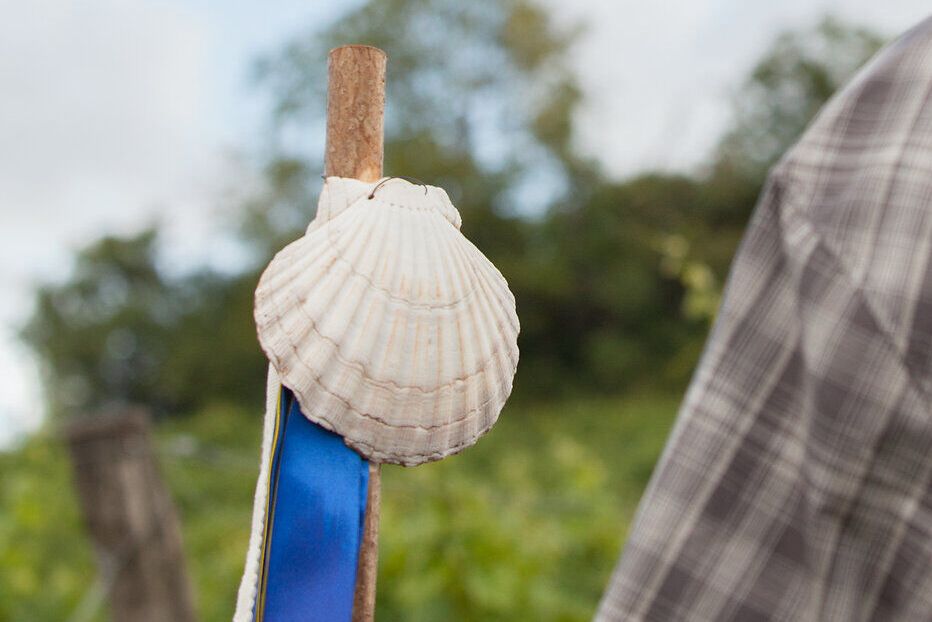
During a European celebration in Santiago in 1982, Pope John Paul II called on the Old Continent to rediscover its roots, thereby sparking an incredible resurgence in the Way of St James pilgrimage. In 1993, the main Spanish route, the Camino Francés, which stretches 780 km from Saint-Jean-Pied-de-Port in the Pyrenees to Santiago, was inscribed as a UNESCO World Heritage site. Prior to this, back in 1987, the Council of Europe had already designated the Way of St James in Europe as a Cultural Route. It is no coincidence that the stylised scallop shell, the symbol of the Way of St James, bears the blue and yellow colours of the European flag. The Way of St James and the scallop shell are symbols of European unity.