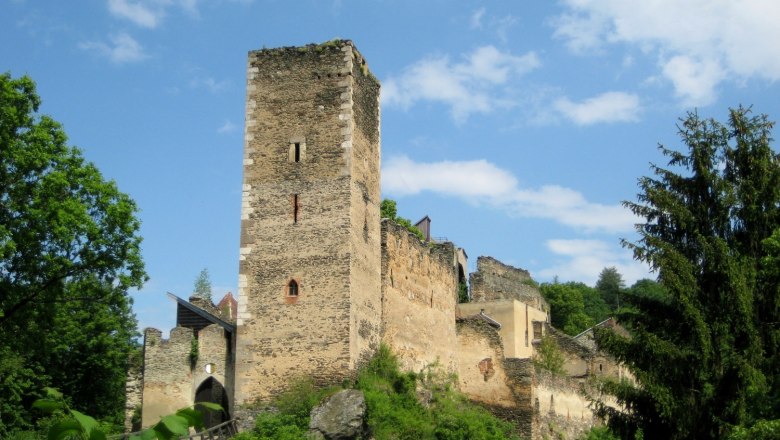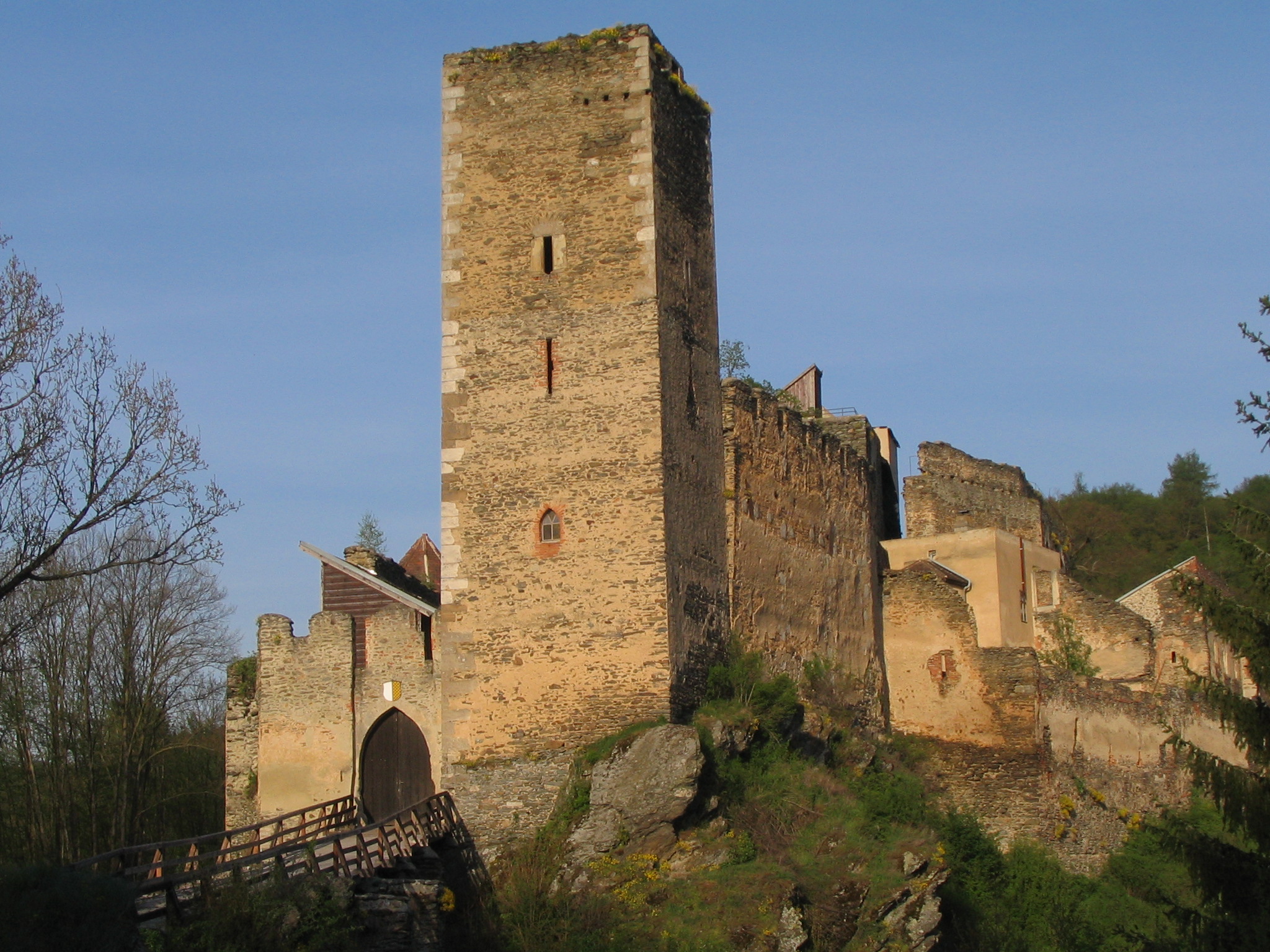
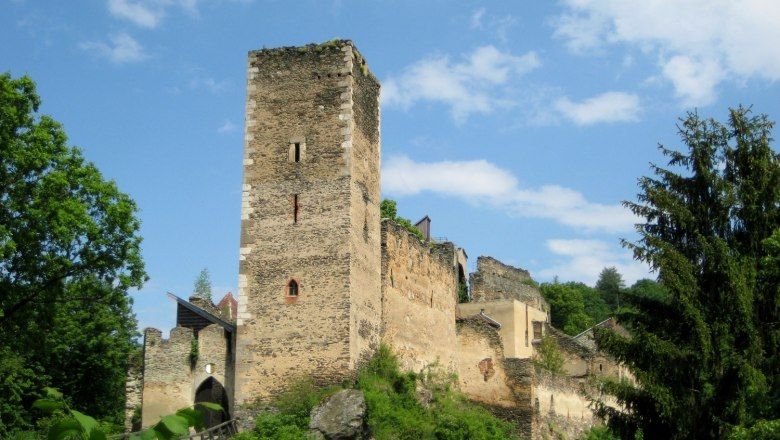
The Kaja Castle Ruins are an over 800-year-old hilltop castle located east of Merkersdorf in the Thayatal National Park. It is picturesquely situated in unspoiled nature along the Kajabach stream near the Thaya River and offers a sweeping view of the national park forest and the romantic valley from the 23-meter-high, still-preserved keep.
Layout
The Kaja ruins are built on a rocky ridge flanked by the Kajabach and the Merkersdorfer Bach. Access is possible only via two bridges. Between the first and second bridges stands a gatehouse with the first castle gate, which was formerly expanded into a gate tower. The second bridge spans 40 meters, connecting to the castle. The entrance to the castle was secured by the second castle gate with a drawbridge. Inside the castle, there is first a small forecourt, which was separated from the inner castle by the third castle gate. This gate was formerly equipped with a portcullis that hung freely from the wall of the outer bailey. Only a few stones from the slide track remain visible today.
The main building (palace) was reserved for the lord of the castle, his family, and high-ranking dignitaries. It is flanked by two former towers: the keep to the west and the Torgaden Tower to the east. These towers used to be 1–2 stories taller. Access to the keep’s observation deck is via a narrow staircase built into the wall. From the top, visitors can look out over the forested Kajabach Valley all the way to the Czech Republic.
The Oldest Part of the Castle
A staircase carved into the rock leads through the fifth castle gate into the central courtyard and thus into the oldest part of the castle. The massive shield wall is particularly striking. It protected the residential building from projectiles but, with its double battlement, also served as an important defensive feature. During the Renaissance, the courtyard was built over, and large window openings were cut into the thick shield wall.
Special exhibitions and displays on the castle’s history invite you to explore. But you should also be sure to see the great hall, the well, the armory, the knights’ hall, the chapel, and the dungeon.
The castle has a bus parking lot and is particularly well-suited for company outings and school field trips. Group tours are available at any time by appointment. The Knights’ Hall, chapel, and castle courtyard can be rented for weddings and celebrations.