
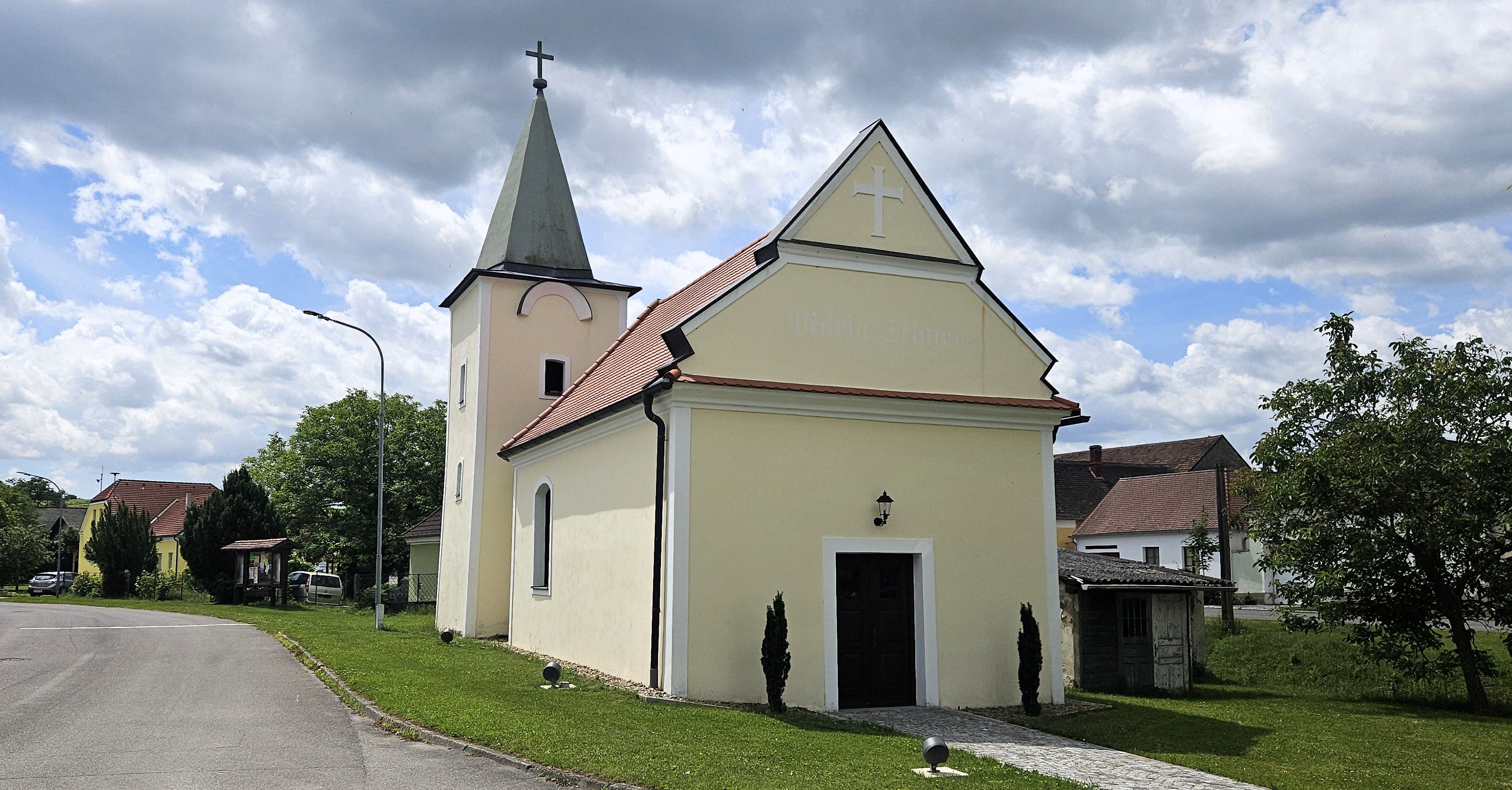
Snow in August? According to legend, that is exactly what is said to have happened in 4th-century Rome. A childless, wealthy couple wanted to dedicate their fortune to the Mother of God—and asked for a sign as to how. That night, Mary appeared in a dream to both the couple and the pope: a church was to be built where snow lay the next morning, in the middle of the Roman summer. And indeed: a white blanket lay on the Esquiline Hill, even though it was hot—and Santa Maria Maggiore was built.
The legend found an astonishing number of places where it lived on—including here in the Weinviertel—a common thread of faith stretching from Rome all the way to our local villages.
In Dürnleis, this devotion took the form of a Baroque structure from the first half of the 18th century: a circular choir apse, a blind gable divided by a cornice, a rectangular portal, and windows with flat arches. Adjacent to the eastern apse is a two-story tower with a masonry pyramidal spire.
Inside, visitors find a two-bay space with a cross vault and square vault, featuring molded cornices—and in the round-arched niches of the apse stand Baroque sandstone statues of Saint Florian and John the Baptist. A Baroque stone altar table serves as the altar, accompanied by a late 19th-century devotional image of the Virgin Mary on the altarpiece—a quiet echo of the Roman legend that gave the chapel its name.

