
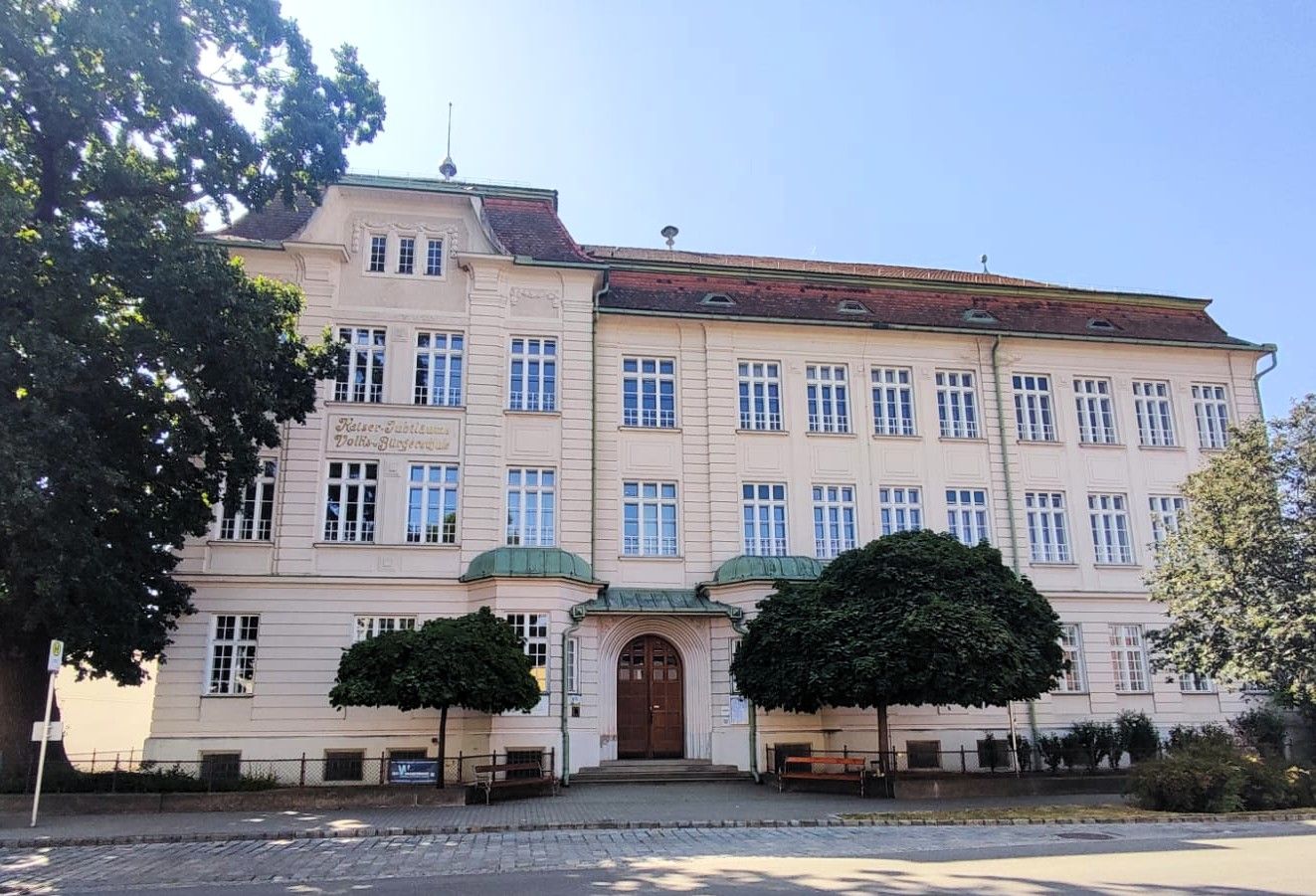
There was a long debate in the town council. In 1909, the decision was finally made: Haugsdorf would get a new school—one that would truly live up to its name. The Kaiser-Jubiläums-Volks- und Bürgerschule was intended not only to provide classrooms, but also a principal’s apartment and quarters for the school custodian. A complete operation under one roof.
A silent financial backer: Officially, the municipality of Haugsdorf financed the construction of the building that today houses the Haugsdorf Middle School. However, minutes reveal that the savings bank not only provided half the property but also covered two-fifths of the construction costs—without making a big deal out of it at the time.
The First Day of School in the New Building
The school chronicle recorded the move in brief but vivid terms:
“On Easter Tuesday, the students were led from the old school to the newly built Kaiser-Jubiläums Elementary and Civic School. Classes began there that very day.”
Elementary school children from Haugsdorf and Auggenthal filled the new classrooms. The Bürgerschule—a unique Austrian institution that went beyond the educational goals of the elementary school—attracted students from a wider area: pupils from surrounding communities came on foot or by train. Boys were allowed to attend the Civic School from the very beginning, while girls were admitted only a year later. Among the alumni is Lois Schiferl, a dialect poet from Hadres, who repeatedly reflects on his school days in Haugsdorf in his autobiographical writings.
Gymnasium and a Motto on the Facade
The new gym was a welcome innovation: for the first time, physical education classes were possible even during the cold seasons. Previously, only the grounds of the Meierhof had been available for this purpose. Gymnastics clubs from the region were also allowed to use the gym.
If you look closely at the exterior facade, you’ll discover a coat of arms featuring four intertwined Fs arranged in a cross. They represent the motto of the physical education pioneer Friedrich Ludwig Jahn—known as “Turnvater Jahn”—which reads: Fresh, pious, cheerful, free. A motto that is doubly fitting here: as a symbol of the gymnastics movement and as a quiet commentary on a school that united education and physical activity under one roof.