Grenzlandorgel Stronsdorf
Handicraft, Historical sites
-
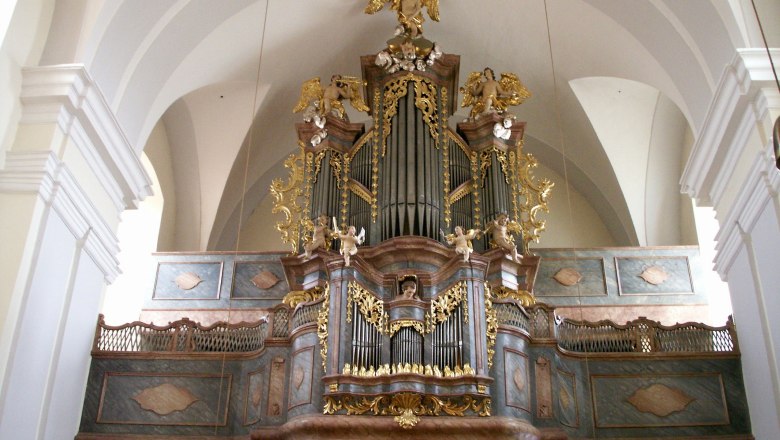
Borderland organ in Stronsdorf©
Description
The Borderland organ by Jan Vymola: The fortified church from the Middle Ages, with its baroque interior, is dominated by a magnificent organ in the west. This organ was built around 1750 and underwent many changes in the following eras. In the 1990s, Ferdinand Salomon gave the magnificent piece a new lease of life by carefully and painstakingly restoring the case, chests and pipework with his workshop, building a new stop action with console and a new bellows system that can be operated manually or electrically. The organ committee regularly organizes concerts by renowned organists.
The Grenzland organ by Jan Vymola (around 1750) in Stronsdorf
The market town of Stronsdorf lies to the north of Vienna in the "Land um Laa". The fortified church there dates back to the Middle Ages. The baroque interior is dominated in the west by a magnificent, rather oversized organ. To understand the eventful history of this instrument, it is good to know a few things first.
In 1334, the Stronsdorf landlord Eberhard III von Wallsee founded the Cistercian abbey of Säusenstein upstream on the Danube, in the area of today's Melk. Stronsdorf became the parish of this abbey in 1351.
Around 1750, Abbot Romanus Mayerl ordered a new, single-manual organ with pedal for the collegiate church in Säusenstein, which was to be placed in front of the towering west wall of the choir. This instrument does not seem to have been sufficient for the Cistercian abbot, and he appears to have purchased a larger one for his collegiate church, which had become available in Herzogenburg due to an (even larger) new building. The ordered organ, too small for the abbot of Säusenstein, seems to have been given to the collegiate parish of Stronsdorf, where it received its color version. Too "small" for Säusenstein, the instrument was now a touch too large for Stronsdorf: The timpani angel crowning the organ was thankfully free from giddiness, as it was quickly tilted and hung in the vault!
After almost half a century, the first changes were made. The following note was found in the windbox of the Rückpositiv on the occasion of the last restoration:
"In the year 1793 in the month of September, this positive organ was completely rebuilt by the artful Mr. Wenzel Ockenfuß, a bourgeois organ builder from Mistelbach, and the whole organ was embellished with a string [r]- and bassoon bass, together with a new keyboard and three new beams [bellows are meant, of course!] at the instigation of the pastor at the time, Andreas Johann Nepomuk Krickel, in order to glorify the praise of God more."
The organ had thus been moved to the back, the pedal had been extended by a 6' fifth and a bassoon; Ockenfuß placed a positive with four doublets of Hauptwerk stops in the parapet, without any sound crown, and the new console was added to this Rückpositiv. However, the "glorification of the praise of God" gave the instrument a rather complicated and not very elegant action and stop action. However, the organ was of such solid substance that it was largely able to save its soul through this rebuilding and various repairs, interventions and botch-ups of the 19th and 20th centuries.
In the years up to 1997, Ferdinand Salomon gave the magnificent instrument a new lease of life by carefully and painstakingly restoring the case, chest and pipework with his workshop, building a new stop action with console (based on the Ockenfuß model) and a new bellows system that can be operated manually or electrically.
The instrument is not signed, but it was clear that it must come from the Brno organ building tradition. In order to revive the instrument to its former glory, i.e. to restore the missing and altered parts to their original state, it was essential to find out more about the unknown builder of the organ.
After visiting organs by Richter and Sieber in Moravia, a very exciting discovery was made in the parish church of Doubravnik: the organ there by Jan Vymola (1722-1805) was identical in many details to the one in Stronsdorf. Salomon examined two other Vymola organs in Nikolsburg (Czech: Mikulov) - again striking similarities: Vymola had thus irrefutably confirmed himself as the builder of the organ created for Säusenstein and located in Stronsdorf. Vymola had a good reputation as an organ builder in Baroque Lower Austria; there is still a choir organ by him in the Cistercian monastery of Heiligenkreuz.
What makes the Vymola organ in Stronsdorf so attractive?
Let's remember: the instrument was originally a single-manual, but how richly it was scored. The sumptuous Principal Pal choir is particularly splendidly colored by two fifths and a fivefold mixture (with a third choir). There is a suspended stop for mystical things. The flutes are relatively narrow, and there is a bell-like quintdena; the finely shaded base is particularly attractive, but masses of sound could - and can! Ockenfuß then added two typically southern German voices to this pedal. It is not quite clear why he built the Positiv only as a collection of doubles of Vymola voices and without any sound crown. This may have been due to stylistic sensibilities of the Josephinian period, it may also have been practical, as it gave the organ a continuo part for figured church music of the classical period; it may also be explained by Ockenfuß's reverence for Master Vymola - the result is in any case a rather charming one!