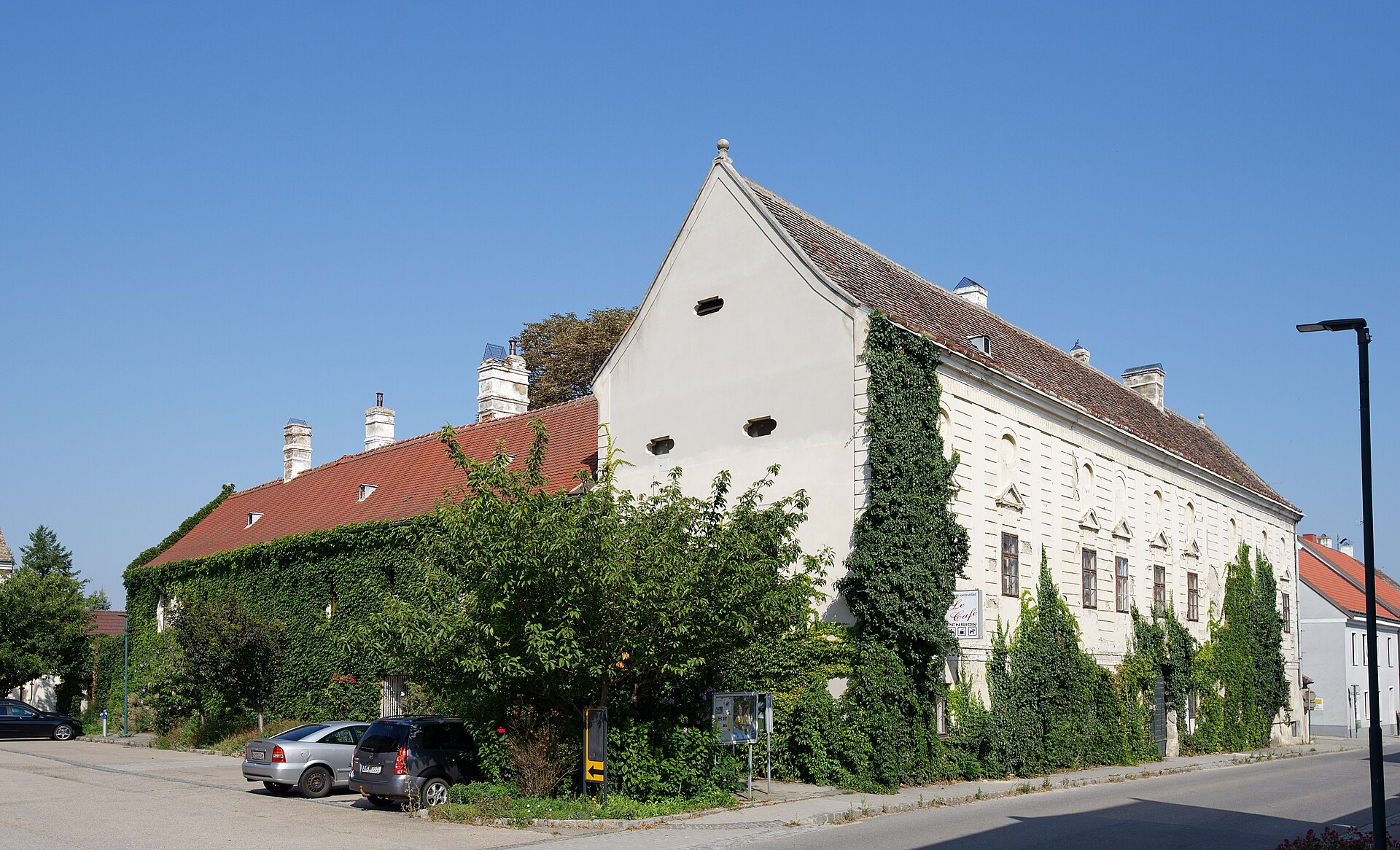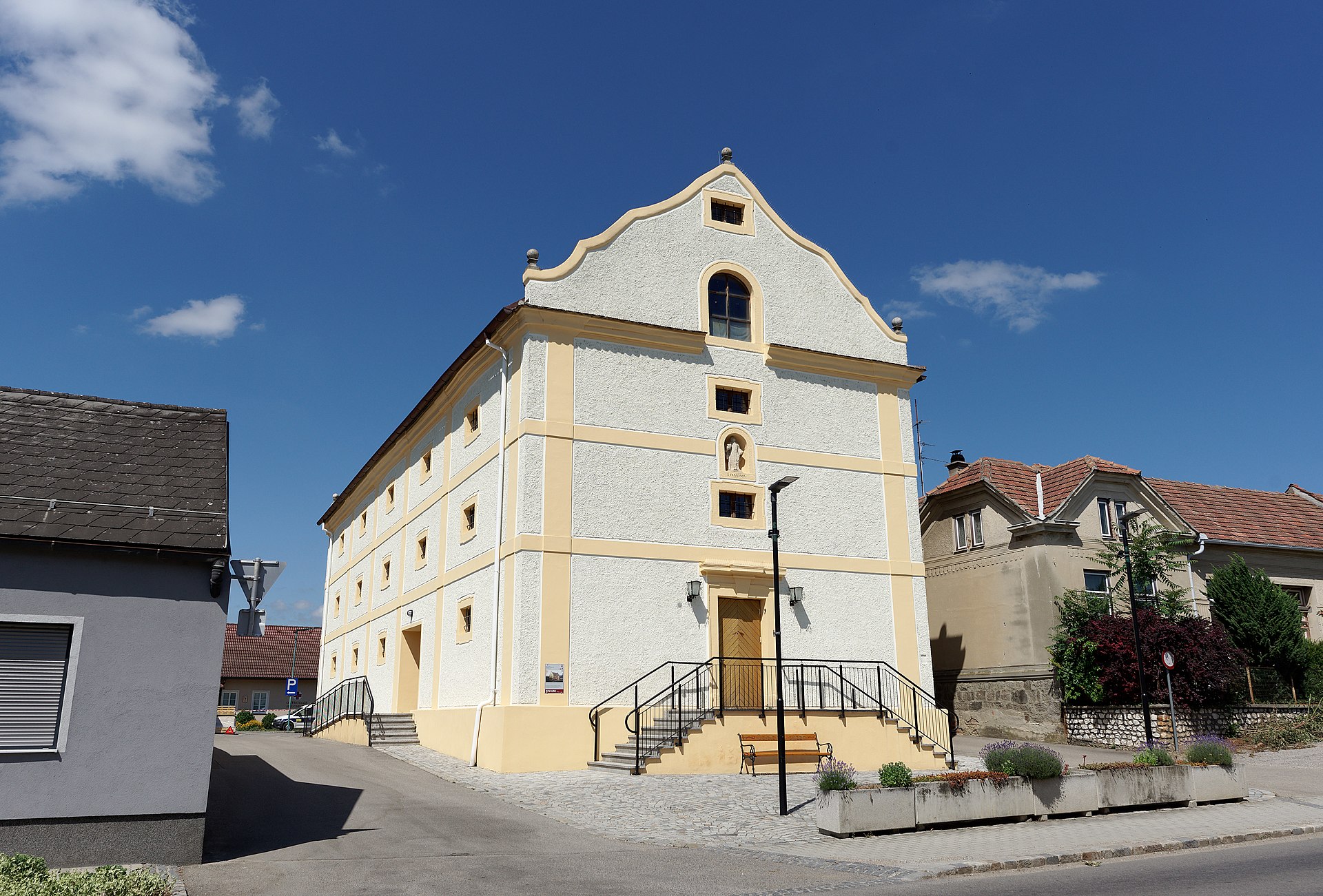
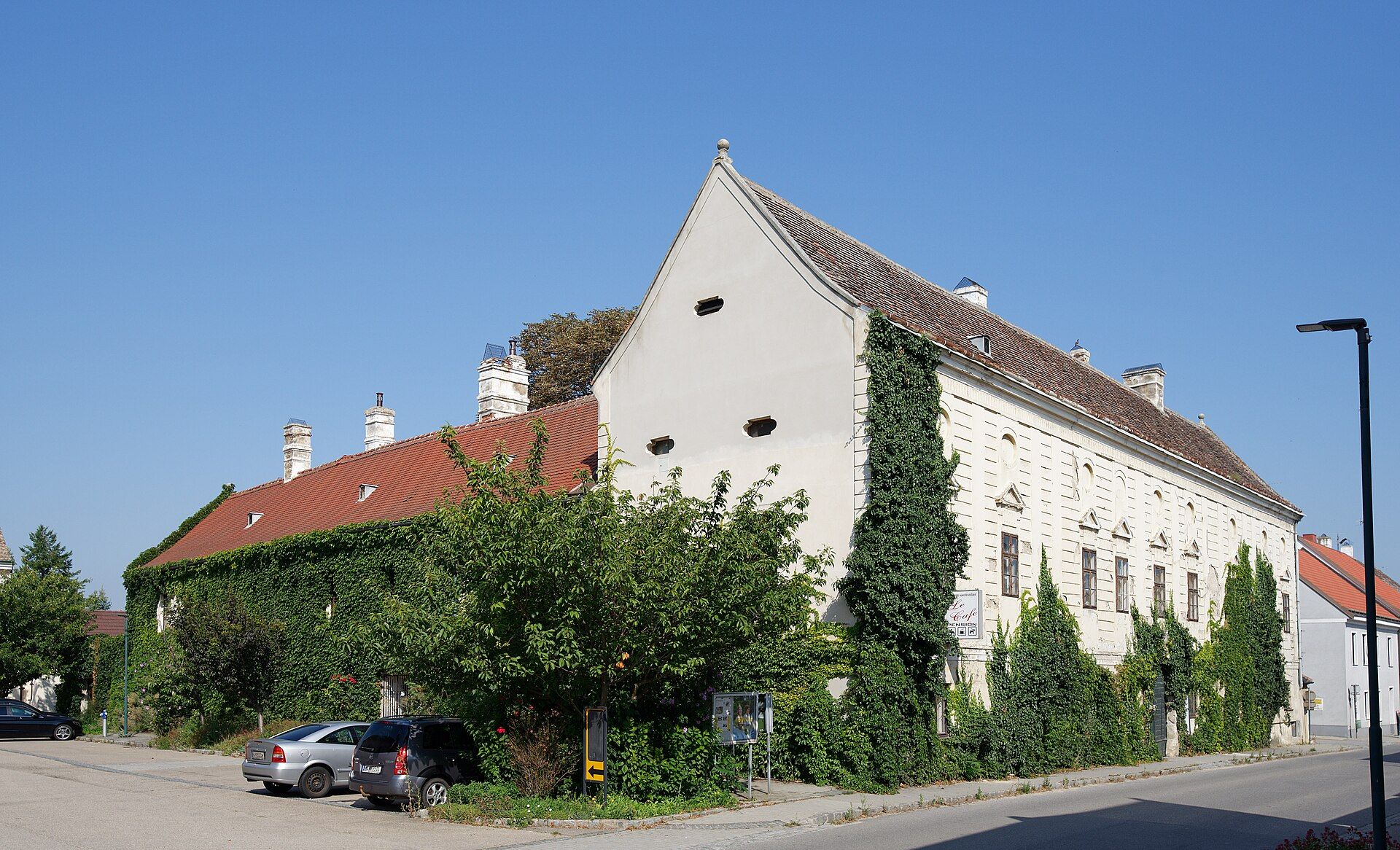
Haugsdorf was first mentioned in a medieval document in 1108. Over the centuries, noble families and regional rulers took turns as lords of the domain. Alongside it existed a second domain—a moated castle—which fell into ruin after the Thirty Years’ War and of which only fragments remain today: When the old horse trough on the main square was removed in 1886, massive building stones and fragments of columns were discovered that are believed to have come from it.
A Castle That Didn’t Want to Be One
During the Thirty Years’ War (1618–1648), the estate came into the possession of Baron Christoph Sigmund von Kirchberg, who converted the simple farmstead into a castle. One detail on the façade still reveals its original purpose today: the double-arched windows on the gable of the east wing indicate a former grain store—a granary, not a reception hall.
From 1810 to 1819, the castle housed Haugsdorf’s first pharmacy. Afterward, the municipal office, district court, tax office, and notary’s office moved in—government agencies that did not relocate to the new building on the main square until the opening of the savings bank building in 1886 and 1963, respectively. For generations, the castle served as the administrative heart of the town. In the late 1950s, the building came into private ownership and was used as a castle hotel with a restaurant, pub, and coffeehouse.
By the way: Scholarships from the foundation: The Barons of Kirchberg, whose history can be traced back to the year 1094—with “Cadeloch von Kirchberg” as their verifiable progenitor—formed the “Haugsdorf Estate,” which comprised a large tract of meadows, vineyards, and farmland. After the death of Francisca Polixena von Kirchberg in 1710, the “Baron von Kirchberg Endowment Fund” was established, which also included the Haugsdorf estate. When the Revolution of 1848 abolished feudal estates, the Baron von Kirchberg Foundation was transformed into a charitable, earmarked institution that awards scholarships to those in need.