
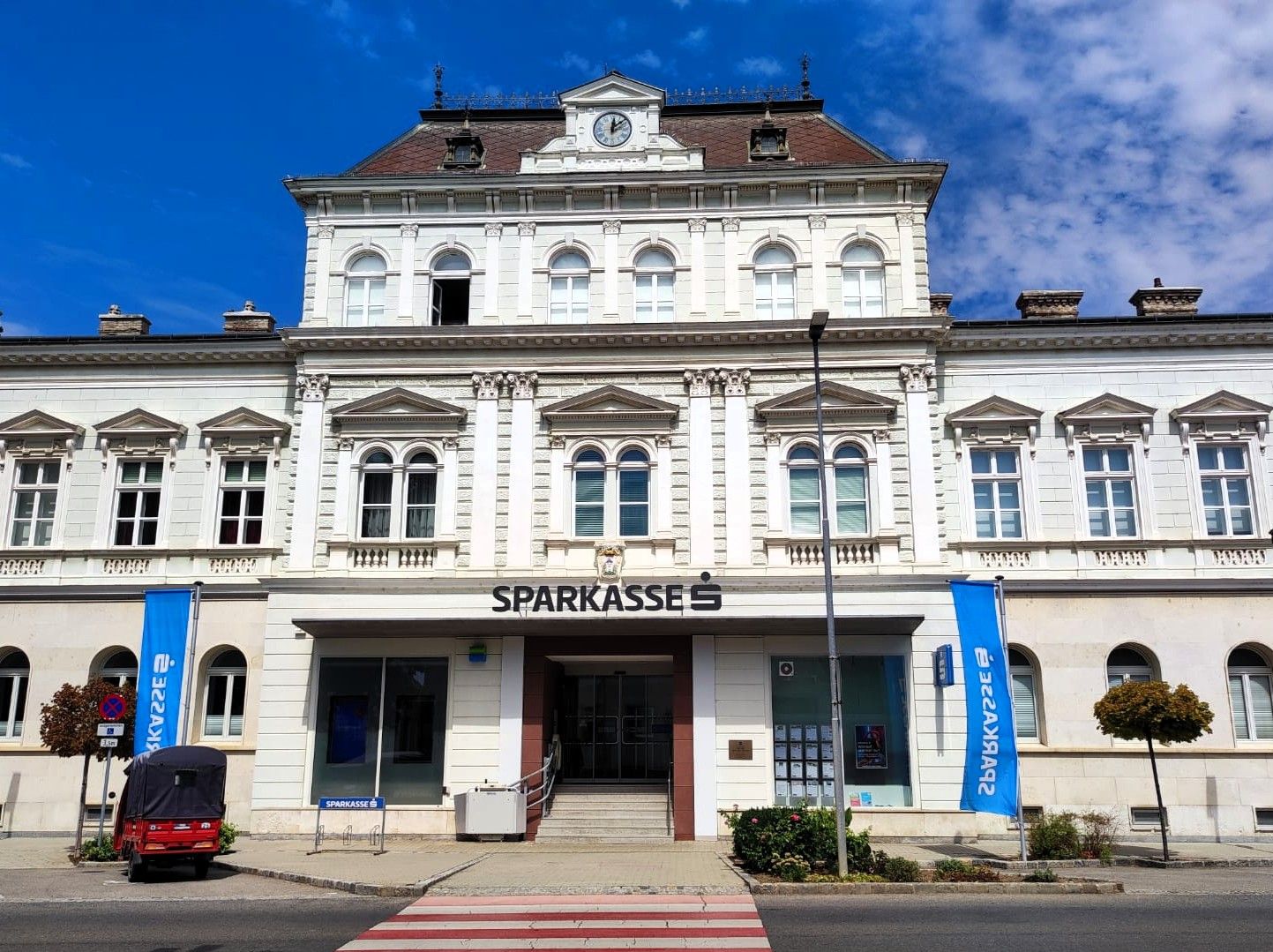
Anyone strolling through Haugsdorf’s main square can’t help but notice this magnificent Wilhelminian-style building—and shouldn’t miss it. The Sparkasse is one of the most impressive buildings far and wide: a late-historical structure in the Italian Renaissance style that was celebrated even at its opening in 1886 as a “magnificent building that would be a credit to any major city.” The building has lived up to that assessment to this day.
A Founding with a Hiccup
The history of the Haugsdorf Savings Bank actually begins with a failure. In 1872, dedicated citizens first planned to establish a savings bank—but the project never came to fruition. It wasn’t until 1873 that a new committee was formed, this time with a clearer plan: it was to be an independent institution, separate from the municipality. A district judge, a notary, a merchant, a pharmacist, and other prominent figures jointly drafted the bylaws.
On April 12, 1874, the time had come: The savings bank association was incorporated, and the bylaws were approved by the Imperial-Royal Governor’s Office. Two rooms on the first floor of Josef Schachhuber’s house at No. 4 were rented as the first business premises.
A Building Saves the Market Town
That these two rented rooms would become a prestigious new building just ten years later—no one had seriously considered that possibility at the time of the association’s founding. Architect Josef Drexler from Vienna won everyone over with his plans for a Renaissance-style building that was also intended to house the district court, tax office, and registry office. It is only in hindsight that it becomes clear this was more than mere spatial planning: Without sufficient space in Haugsdorf, the government offices would have been relocated to Seefeld Castle—an economic loss that would have severely impacted the market town. The new savings bank building—completed in the remarkable time of less than a year—prevented exactly that.
What the building has to offer
A glance inside reveals details that have stood the test of time: the cast-iron staircase railing, the mirrored vaulted ceiling, and the etched-glass windows. In the attic, a tower clock ticks away; for 130 years, it was wound by hand almost daily—it wasn’t until 2015 that an electric mechanism took over. The ground floor has been modernized several times over the decades; this has in no way detracted from the building’s character.
The building is still owned by Sparkasse Haugsdorf. In addition to the bank, it now houses a notary’s office as well as other medical offices and residential spaces—the building remains what it has been from the very beginning: a hub of public life in Haugsdorf.