

EV13 Stage 9: Valtice - Mannersdorf
Use our AI guide
Do you have any questions about your stay?

Cycling tour Starting from Valtice
Start: Valtice / Finish: Mannersdorf
Start: Valtice / Finish: Mannersdorf
From Valtice, drive via Boří Dvůr to the Břeclav-Poštorná/Reinthal border crossing.Before heading to Austria, you can stop for refreshments in Břeclav, visit the Liechtenstein House or walk to the confluence of the Dyje and Morava rivers, where the remains of the original border fence have been preserved.The Iron Curtain Trail leaves the Czech Republic near the confluence of the Dyje and Morava rivers near Břeclav and then crosses routes on the territory of Austria and Slovakia.
From Valtice, drive via Boří Dvůr to the Břeclav-Poštorná/Reinthal border crossing. Before heading to Austria, you can stop for refreshments in Břeclav, visit the Liechtenstein House or walk to the confluence of the Dyje and Morava rivers, where the remains of the original border fence have been preserved. The tour then continues by crossing the Czech border at the Moravský Svätý Ján / Hohenau border crossing. The small town of Hohenau at the confluence of the Morava and Dyje rivers in the Czech-Slovak-Austrian border triangle also offers the unique Morava-Thaya floodplains in its immediate vicinity, one of the best-preserved wetlands in Central Europe, where you can also observe birds. The route continues to meander across the borders of Austria and Slovakia, which it copies almost along the western side of the Slovakian border line. On the Austrian side, you return via the border crossing in Záhorská Ves and the small town of Mannersdorf an der March.
Please don't forget your passport!
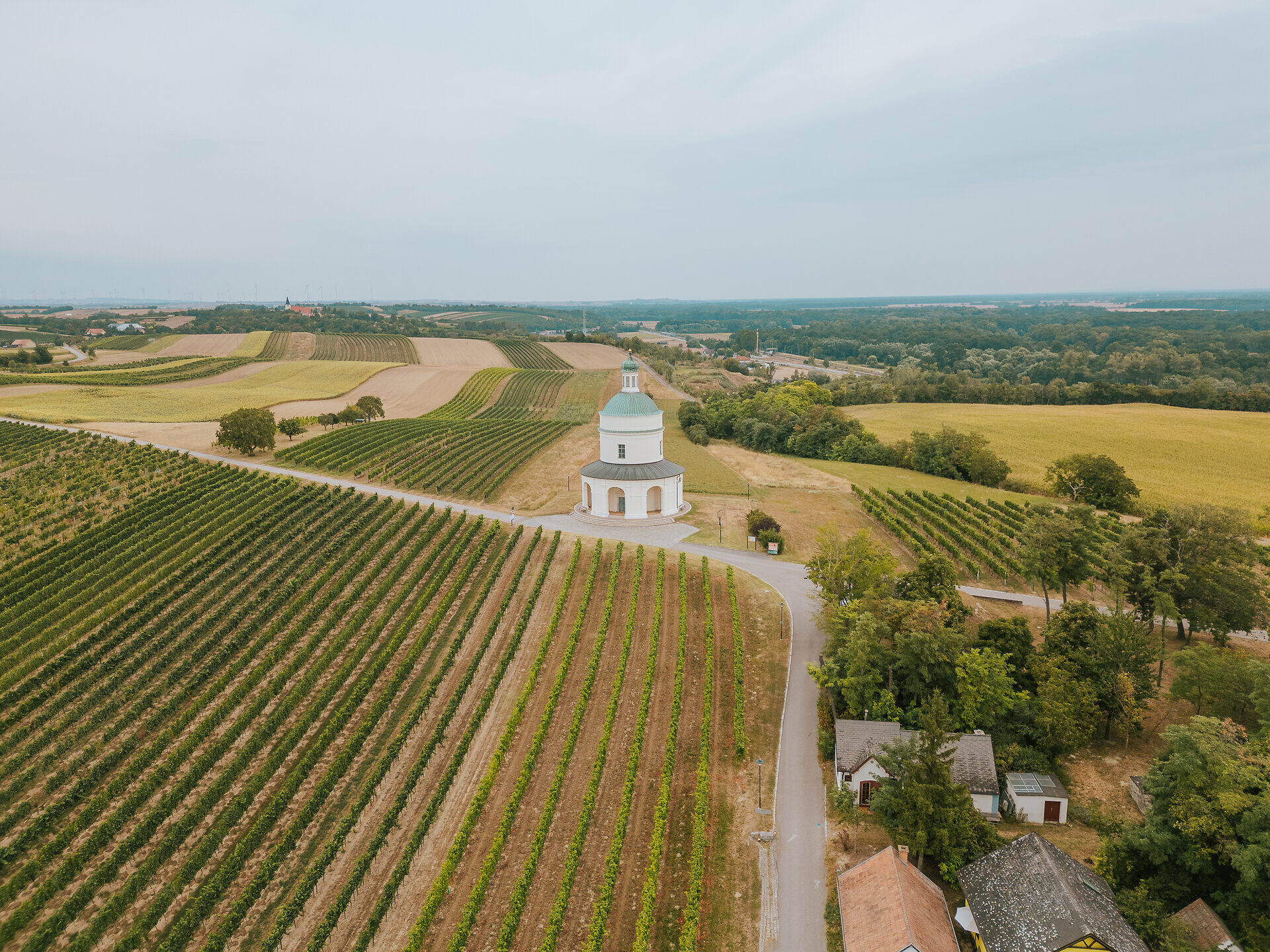
The route leads from Valtice to the Austrian side through the Reinthal border crossing. On the way to Altlichtenwarth you can look forward to the Dreiländerblick, which offers a beautiful view of the northeastern part of Lower Austria, the Czech Republic and Slovakia if the weather is good. In the Altlichtenwarth the Silberberg cellar lane is worth seeing. After passing through the long village of Hausbrunn, you will reach Hohenau an der March. Here lie the floodplains of the Thaya River, one of the most interesting wetlands in Central Europe! Worth mentioning are a diversion to the confluence of the Morava and Dyje Rivers in the border triangle (A/CZ/SK) and a visit to the bird sanctuary. This area at the confluence of the Morava and Dyje Rivers is sometimes referred to as the “Moravian Amazon”. Continue eastwards along the Marchstraße to the bridge over the Morava River to Slovakia. The route leads along the road towards Moravský Svätý Ján, then continues across the field. In this part of the route, up to Malé Leváre, herons or storks often fly over cyclists’ heads. After the village of Malé Leváre, the route returns to the Morava River and follows the Rudava River. After crossing the Morava River in the village of Záhorská Ves, you will return to the Austrian side, to the little town of Angern, and from there you will soon reach Mannersdorf an der March. Mannersdorf is known for its excellent wines and idyllic wine cellars. Some 129 wine cellars are arranged in seven rows above each other. The Rochuskapelle (chapel) is worth seeing here. It was built in 1638 as a plague chapel and is one of the most important Italian Renaissance buildings in Lower Austria. You can enjoy a wonderful view of Slovakia and Austria from here.
If you still do not want to leave the Czech Republic and would like to taste good wine, go to the Blue Mountains (Modré Hory). The landscape of the Blue Mountains, where the varieties with blue grapes are grown on more than half of the vineyards, has the shape of a hand opened wide towards the flat south. The hand’s fingers are made by five wine-growing villages: Vrbice (the highest situated), Velké Pavlovice, Němčičky, Kobylí and Bořetice.
Leider können wir Ihnen zum jetzigen Zeitpunkt keine Wetterdaten für den Ort anzeigen.
Wine cellar lane Silberberg in Altlichtenwarth
Bird-watching spots in Hohenau
St.Rochus Chapel in Mannersdorf/March
Letzte Änderung: 3 Aug 2026